


AI
Why hospitals and health systems are trimming vendors from their AI roster
Epic's AI capabilities are giving providers an alternative to adding another vendor.

Published
July 13, 2026
2:24 pm
|
Updated
August 28, 2026
1:05 pm
Hospitals and health systems’ relationship with AI is getting more refined as industry executives figure out what they want and don’t want from the software.
For hospital and health system executives, that means identifying when their ROI in a given AI application is good enough to keep it in use, and depending on the use, deciding if it is worth keeping a separate vendor around to manage that function.
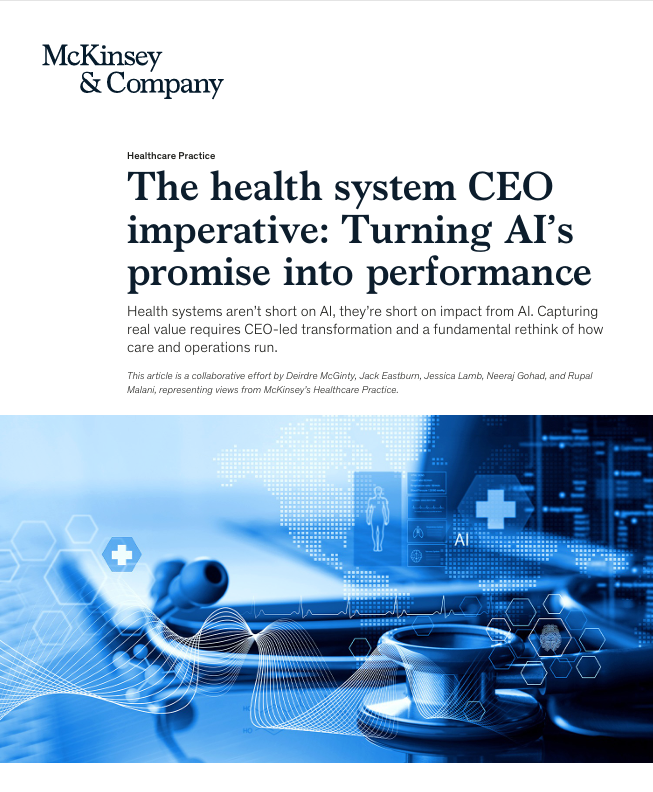
And consultants at McKinsey & Co. argue in a report that narrowly adopted use-cases of AI in healthcare are driving a broad lack of progress in using AI.
“Many organizations have looked at AI with a bolt-on mindset rather than a transformation mindset,” wrote the authors of the report, titled The health system CEO imperative: Turning AI’s promise into performance. “The consequence is a proliferation of point solutions and pilots without the integration or scale required to create enterprise value,” they wrote.

People are slow to change
In an interview, one of the report authors, Jessica Lamb, a partner in McKinsey’s New York office, said that part of the issue is cultural in nature.
“It’s a little bit more about doing things how they can and should be done as opposed to the way they’ve always been done,” Lamb said. “There’s a lot of momentum behind continuing to do things as they as they have been done. But I think the productivity improvement, the productivity unlock comes from not just changing a piece of a process but actually rethinking the whole process from beginning to end.”
That parallels the experience of Kevin Coloton, CEO of HURC, a revenue cycle management company, who said that a lack of ROI on AI implementations is driving much of the retraction of vendors at health systems.

“Point solutions still provide value there. But when an integrated larger player can do something that’s close to equivalent there’s a preference to reduce the vendor account to be consolidated,” Coloton said.
Epic’s role
And one of the questions that CFOs and other hospital leaders are asking about an AI technique or application is “Can Epic do this?”
“I am in many conversations where the (leaders of an) organization state that they’re quote, an Epic-first organization, meaning if Epic can do (it) or Epic plans to in the near future, it will change the evaluation of vendor options,” Coloton said.
“This Epic-first mindset is real, and needs to be an important consideration,” Coloton said. “These organizations have spent a lot of money to partner with Epic, and they want to maximize the return of that investment, which I think is a hundred percent appropriate.”
That said, Epic can’t do all things, and it becomes an important task to figure out if Epic can handle it.

“If so, great, there is no point of adding another vendor. But there are going to be many, many different workflows and tasks that Epic is not at the moment or maybe even in the future going to go into,” said Srulik Dvorsky, CEO and co-founder of TailorMed, a healthcare tech company.
That means vendors are going to still play a major role in implementing AI, at least for the time being.
“And then the question is, as a vendor, how well do you work with Epic? And I think that you need to recognize that it’s a partnership that needs to be there and (be) robust,” Dvorsky said.
