



Single-payer system to cut $300 billion from providers: analysis
A hospital advocate warned single payer would not produce universal comprehensive, affordable healthcare coverage.

Hospitals and other providers would face a $300 billion annual revenue cut under a single-payer approach that sets all payments to Medicare rates, according to a high-profile Yale analysis.
Adopting a single-payer system would save more than 100,000 lives and cost $1 trillion less each year, claims a new preprint study led by researchers at the Yale School of Public Health.
The source of savings, according to analysis, include:
- $378 billion from lower pharmaceutical prices
- $296 billion from Medicare-level payments to providers
- $286 billion from reduced administrative overhead
- $286 billion from reduced fraudulent billing
- $100 billion from fewer avoidable emergency department visits and hospitalizations
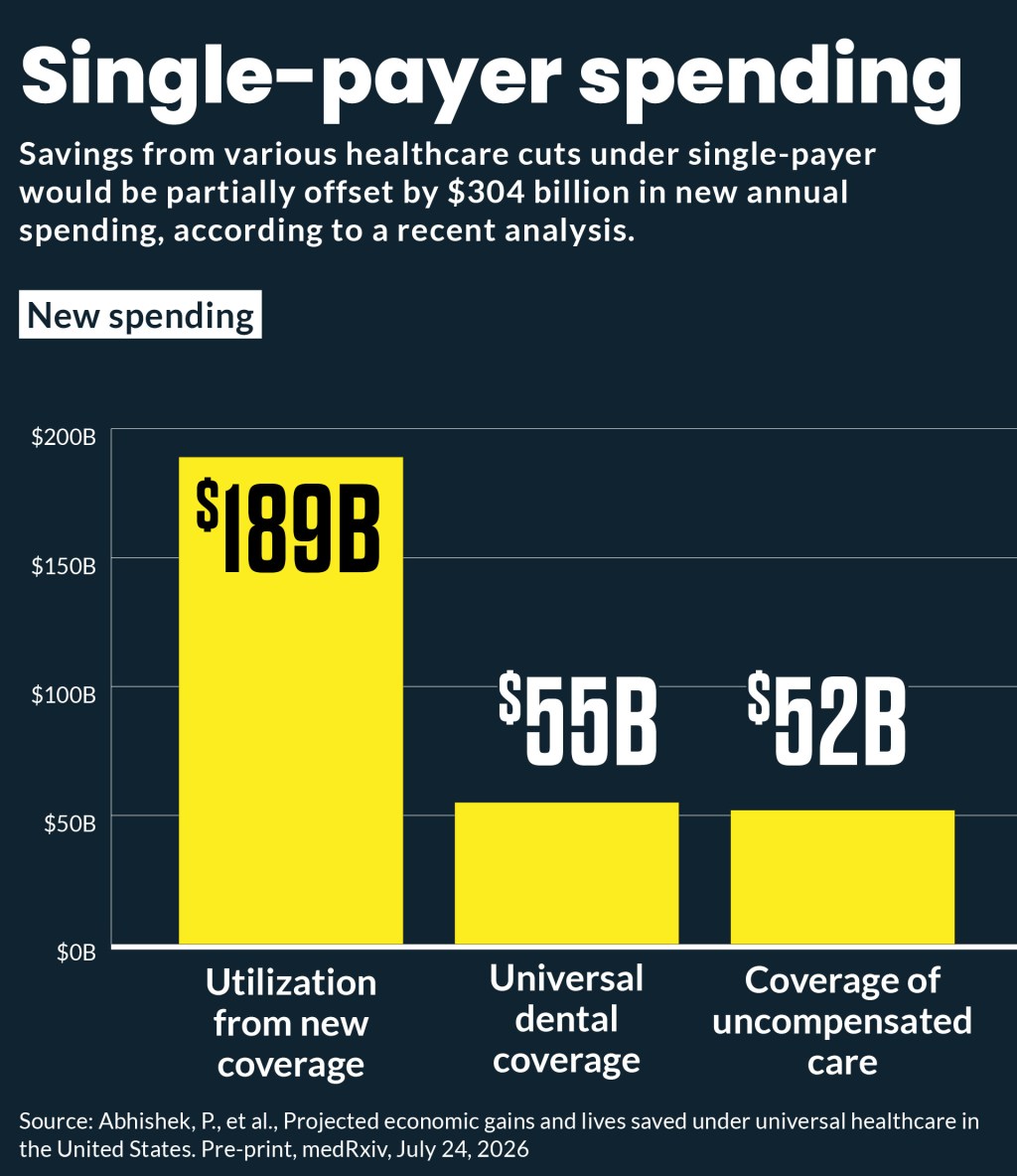
The overall savings would be reduced from some additional costs, including $198 billion from increased utilization by the uninsured or underinsured and $52 billion from fully covering uncompensated care.
Do hospitals benefit?
Single-payer supporters highlighted the projected benefits alleged by the analysis and specifically hailed the expected benefits for hospitals and other providers.
“This analysis shows we can guarantee health care to every American and save our country more than $1 trillion every year,” Rep. Ro Khanna (D-California) said in a press release. “We can also strengthen our hospitals by ensuring they are paid for care that currently goes uncompensated and reducing the enormous administrative costs of our current system.”
Khanna, who some news outlets have described as a potential presidential candidate for the 2028 Democratic party nomination, said the analysis was conducted at his request to understand “the economic impact of a single-payer universal health care system.”
A hospital advocate pushed back on the claim that a single-payer model would strengthen hospitals.
Lisa Kidder Hrobsky, senior vice president of government relations at the American Hospital Association (AHA), said the approach would not produce universal comprehensive, affordable healthcare coverage.
“Instead, they would sharply reduce access to care for patients in communities across the country,” she said in comments emailed to FastFinance.
She noted that the proposal would replace employer-sponsored coverage plans for 180 million Americans, many of which offer benefits that Medicare doesn’t.
She also targeted the universal adoption of Medicare rates by noting that Medicare paid just 83 cents for every dollar spent caring for Medicare patients in 2023.
“This resulted in $100 billion in Medicare underpayments that year alone,” Kidder Hrobsky said.
The projected savings are an increase from the $450 billion savings the authors projected in a 2020 study on the adoption of a single-payer system. The increase stemmed from higher health spending, a widening gap between commercial and Medicare payment rates, and new estimates on both recent policy changes and the underinsured.
Rate impact
Among a range of caveats included by the authors of the analysis was that it did not account for “the responses of providers to Medicare payment rates.”
A 2020 FTI Consulting analysis of Medicare for All-type of single-payer models projected that the resulting reimbursement cuts would result in 90% of hospitals across the country running consistent deficits, increasing the risk of hospital closures nationwide and negatively impacting the healthcare workforce.
That failure and other caveats mean that the authors “did not model reality,” Jessica Riedl, a budget and tax fellow at the Brookings Institution, wrote on X. “There’s no modeling of how the system would still deliver care — it’s just an accounting exercise that says the system would be cheaper if it were cheaper.”
Instead of hospital closures, the most likely effect of such a single-payer model would be extreme specialization by hospitals, said Michael Baker, director of healthcare policy for the American Action Forum, extreme specialization by hospitals.
“Hospitals may be less of a one-stopshop and more — because of the resource constraints placed on them — end up having to cut certain services in order to expand other services,” Baker said.
Provider benefits
Single-payer supporters noted benefits to providers from a single-payer approach, including the elimination of uncompensated care and more patients through universal equal coverage.
Additionally, the authors said their projections did not account for the reduction in billing costs for providers, which could reach “hundreds of billions of dollars annually.”
However, the financial benefit for hospitals also would come with the downside of big cuts in administrative employment.
Baker cautioned anyone finding any positives in the Yale analysis on common inaccuracies in healthcare policy projections. The latest example of such high-profile inaccuracy was the recently issued analysis from the Congressional Budget Office (CBO) that instead of the Inflation Reduction Act’s Medicare drug negotiation provisions saving $129 billion, as CBO previously projected, the law will increase costs by $700 billion.
“When something is scored as a saver, it doesn’t mean it won’t turn into a spender,” Baker said.
