



Fast Finance
Site-neutral payment changes are most likely congressional reform this year
Congress is about to enter its final legislative sprint for the year.

Published
August 4, 2026
10:35 am
Legislation pushing site-neutral payments remains the most likely healthcare policy change to pass Congress this year, as it enters the final months of the legislative calendar.
Congress is about to depart for its annual August recess, which will leave only a month and a half on the legislative calendar for action before the midterm elections. After the election, Congress will have just a few weeks for end-of-the-year, must-pass legislation, including funding bills.
That tight timeframe to enact mandatory federal funding bills makes an omnibus funding package all but certain, say legislative analysts. Such packages commonly sweep up other bills, especially if they provide savings to the federal government that can offset desired spending increases.
Site-neutral payments
The biggest healthcare funding mechanism, or pay-for, in such a package is site-neutral payments in Medicare or Medicaid, Sheila Burke, RN, a senior strategic advisor at Baker, Donelson, Bearman, Caldwell & Berkowitz, said in an interview.
“From the hospital’s perspective, I think they’ve not yet won the argument that they should, which is that ‘an appendectomy is not an appendectomy.’ There are differences, case mix, all sorts of things,” Burke said.
A 2024 Congressional Budget Office analysis concluded that Medicare site-neutral policies would provide $170 billion in federal savings over 10 years. Those include:
- $157 billion from site-neutral rates for most services to all hospital outpatient departments (HOPDs)
- $5.6 billion for drug administration services at all off-campus HOPDs
- $7.6 billion for imaging services at all off-campus HOPDs
The CMS Medicare outpatient payment proposed rule would cut $190 million in 2027 spending by expanding site-neutral payment for imaging-without-contrast services (including most MRIs) at off-campus HOPDs. That followed last year’s CMS policy change implementing a site-neutral payment policy for drug administration services.
Additionally, Medicaid site-neutral payments would save $172 billion over 10 years, according to a list of options issued by the Republican Study Committee in the U.S. House of Representatives. Those were among a list of proposed healthcare policies, some of which ultimately were included in the One Big Beautiful Bill Act (OBBBA).
Burke said the amount of targeted savings from any site-neutral provisions in an end-of-the-year spending bill would be determined by the motivation behind it. It would be larger if aiming for savings offset or smaller if driven by arguments against facility fees.
“Site neutrality is holding out there as a threat, depending on whether they do it to raise money, whether they do it to respond to the pressure that ‘There’s no particular reason you have to use inpatient facilities to essentially provide services that can be provided otherwise,’” Burke said.
A growing number of both liberal and conservative health policy advocacy organizations have been pushing members of Congress from both parties for site-neutral policies based on such principles.
Hospitals have long raised concerns about the adverse financial effects of site-neutral policies, However, at an April hearing, some hospital CEOs said they would work with Congress on precise site-neutral policies. That included pinpointing which hospital services can be subject to site-neutral payments and which services should continue to be paid more because transferring them to other settings would be impractical.
340B changes
Changes to the 340B program this year look less likely to policy watchers, despite recent legislative activity.
Most likely to pass Congress is a bill, approved July 1 by the House Ways and Means Committee, which would require 340B reporting by not-for-profit hospitals, said Nicholas Nastasi, government and regulatory affairs manager at Faegre Drinker Biddle & Reath.
“It’s possible that some elements like that might find themselves into an [end-of-the-year] healthcare package,” Nastasi said in an interview. “Should that come into fruition, I always like to say, ‘If there’s a will, there’s a way.’ I don’t count them out.”
Burke noted the possibility that Sen. Bill Cassidy, MD, (R-La.), who is leaving Congress at the end of the year, could push for enactment of his 340B bill. That measure includes a range of policy changes that have raised concerns from hospital advocates.
“You have an interesting scenario with Cassidy leaving. What does he care about that he wants to get done before he goes?” Burke said.
More likely is that 340B legislation will be pushed to next year, especially if Democrats gain majorities in the midterm elections, Nastasi said.
“I’m not saying that 340B is off the table this year, Nastasi said. “It could very well be, but that’s dependent on what we see happening in November and then moving into the next Congress.”
Price transparency
Another healthcare policy that is among the most likely to pass Congress this year is price transparency legislation, said Burke.
“So, the whole question of what the consumer needs to know, how it’s provided, in what form over what services, is clearly going to be something I think hospitals need to be alerted to and worried about,” Burke said.
Two House committees and a Senate committee approved price transparency bills in July. Among various other healthcare bills that have made it out of the committees are:
- Health Care Price Certainty for All Americans Act (House Ways and Means Committee)
- Lower Costs, More Transparency Act (House Energy and Commerce Committee)
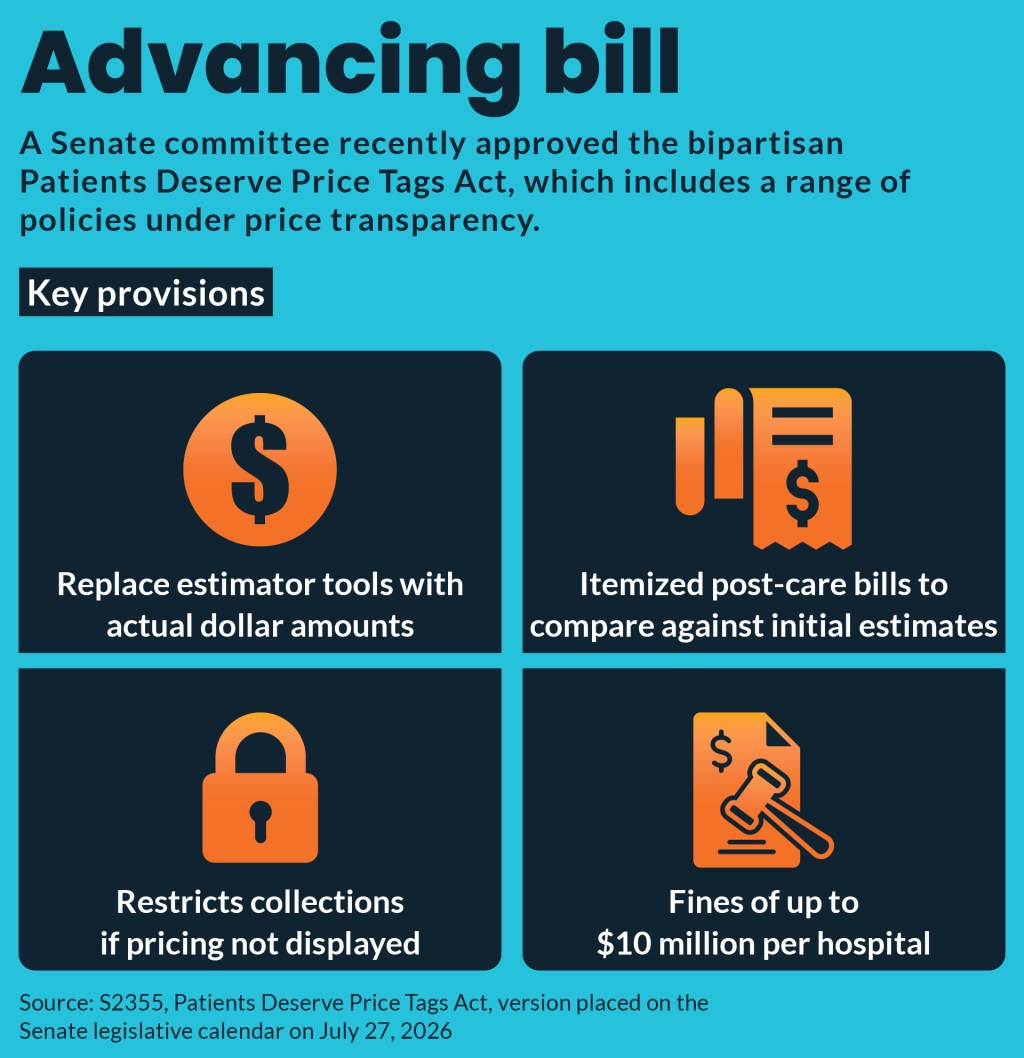
- Patients Deserve Price Tags Act (Senate Health, Education, Labor, and Pensions Committee)
The two House bills push an expansion of transparency requirements to labs, imaging centers and ambulatory surgery centers. The bills also direct HHS to establish uniform formats for the files, allowing for pricing comparisons across healthcare settings. They include escalating fines for repeat violators.
The Senate bill would require insurers to provide advanced explanations of benefits (AEOBs) to insured patients based on good-faith estimates transmitted from providers to insurers. If out-of-pocket costs “substantially” go beyond the estimate on the AEOB, patients would be held harmless for the excess unless the provider can document that the increase is due to unforeseen medical circumstances.
Such bills could get wrapped up in an end-of-the-year healthcare package.
“It could just be the usual end-of-the-year financing packages out of those three committees, and they tend to be made up of bipartisan issues, many of which, like the price transparency stuff, is clearly bipartisan,” Burke said.
