



Reference
Value-based care and alternative payment models: What they are and how they work

Published
September 30, 2026
4:46 pm
|
Updated
October 1, 2026
3:17 pm
Value-based care (VBC) is an approach to healthcare that seeks to improve the quality, outcomes and experience of care while managing its cost. Rather than rewarding healthcare organizations solely for the volume of services they provide, value-based arrangements link some or all payment to measures of quality, outcomes, utilization or total cost of care.
The concept is often associated with the healthcare value equation introduced by Michael Porter and Elizabeth Teisberg in 2006: [1]
Value = Quality ÷ Cost
The basic idea is straightforward. A healthcare system creates greater value when it improves outcomes and quality relative to the resources required to deliver that care.
Nearly two decades later, however, value-based care encompasses far more than a single payment approach. Healthcare organizations participate in arrangements ranging from fee-for-service with quality incentives to shared savings, bundled payments, two-sided risk and population-based payments.
Understanding value-based care therefore also requires understanding alternative payment models (APMs) and the financial risk and operational accountability that accompany them.
What is the difference between value-based care, value-based payment and an APM?
These terms are related but are not interchangeable.
Value-based care describes the broader goal: improving outcomes, quality and patient experience relative to the cost of care.
Value-based payment describes reimbursement approaches that reward performance on measures of value rather than paying exclusively for volume.
An alternative payment model, or APM, is a payment arrangement that moves some degree of reimbursement away from traditional fee-for-service and toward accountability for quality, cost or both.
Other commonly used terms describe specific aspects of this landscape. Accountable care generally refers to arrangements in which participating providers assume responsibility for the quality and total cost of care for a defined population. Population-based payment or capitation provides prospective payment for some or all of the care delivered to a patient population.
An Advanced APM has a specific meaning under Medicare’s Quality Payment Program and includes additional requirements related to financial risk, quality measurement and certified electronic health record technology. [2]
How is value-based care different from fee-for-service?
Traditional fee-for-service payment reimburses healthcare providers separately for visits, tests, procedures and other services. Revenue therefore generally increases as service volume increases.
Value-based arrangements introduce different incentives. Depending on the model, organizations may be rewarded for improving quality, preventing avoidable utilization, coordinating care, managing an episode of care efficiently or controlling the total cost of care for a population.
That does not mean fee-for-service has disappeared. Healthcare organizations increasingly operate in a hybrid payment environment, managing traditional fee-for-service revenue while simultaneously participating in value-based arrangements.
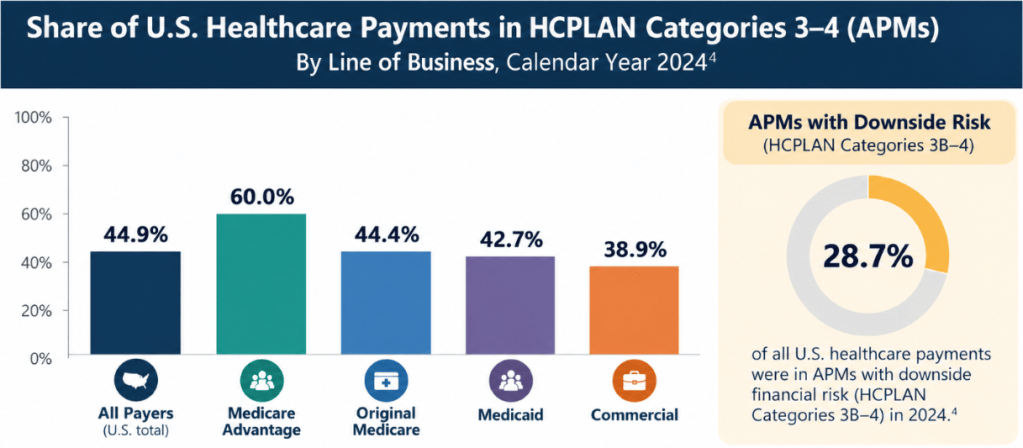
In 2024, 39.7% of U.S. healthcare payments remained in pure fee-for-service arrangements, while 44.9% flowed through Categories 3 and 4 of the Health Care Payment Learning & Action Network (HCPLAN) Alternative Payment Model (APM) Framework, according to the 2025 APM Measurement Effort. Category 3 includes APMs built on a fee-for-service architecture, while Category 4 includes population-based payment. Importantly, not all Category 3 arrangements include downside risk; 28.7% of all U.S. healthcare payments were in Categories 3B through 4, which include downside financial risk. [3][4]
What does value-based care measure?
The specific measures depend on the contract or payment model, but value-based arrangements commonly consider the following. The measures are not interchangeable: a contract may place greater weight on some domains than others, and the measures used should be understood together with the population, episode, performance period and payment methodology. [2][3]
- Quality and measurable clinical outcomes, such as preventive care, chronic disease management, complications, readmissions or other clinical results
- Total cost of care for a defined population or episode, often evaluated against a benchmark or target price
- Population health, including performance across an attributed or otherwise defined patient population
- Patient experience, including measures of communication, coordination and experience with care
- Access to care, including whether patients can obtain appropriate care when and where it is needed
- Utilization, such as emergency department use, hospitalizations, readmissions or post-acute care when relevant to the arrangement
A contract might focus narrowly on a particular procedure or condition, or it might hold an organization accountable for the total cost and quality of care for thousands of patients. For example, an episode-based model may focus on spending and quality during a defined episode, while an accountable care arrangement may evaluate quality and total spending across an attributed population. [2][3]
How are alternative payment models structured?
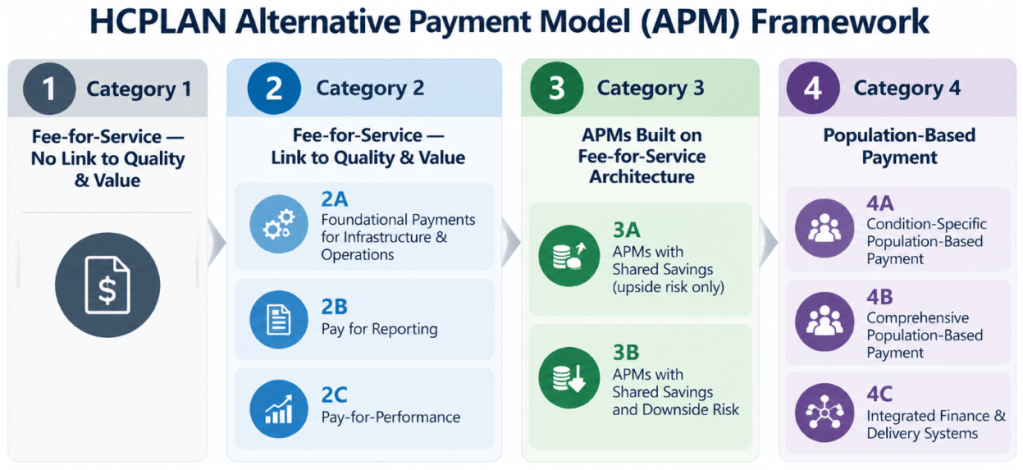
HCPLAN developed an APM Framework that provides a common way to describe the progression from traditional fee-for-service to population-based payment. Rather than treating value-based care as a single model, the framework places payment approaches along a four-category continuum. [3]
At one end, Category 1 is traditional fee-for-service with no link to quality. Category 2 retains fee-for-service but links payment to quality or value through infrastructure payments, reporting or performance. [3]
Category 3 includes APMs built on a fee-for-service architecture. Category 3A includes shared savings without downside risk, while Category 3B includes shared savings with downside risk and certain episode-based arrangements. Category 4 moves to population-based payment, including condition-specific and comprehensive population-based approaches. [3]
HCPLAN factsheet | HCPLAN white paper
The framework is useful because “value-based care” does not represent one particular contract. Organizations can participate in very different financial arrangements while pursuing the broader goal of value.
What are common types of alternative payment models?
Pay-for-performance generally retains fee-for-service payment while adding incentives—or, in some arrangements, penalties—based on performance against specified quality, safety or experience measures. [3]
Shared savings arrangements allow providers to share in savings when the cost of caring for an attributed population falls below an established benchmark while required performance standards are met. Some arrangements also introduce downside risk when spending exceeds the benchmark. [3]
Bundled or episode-based payments establish payment or financial accountability for a defined episode of care. For example, an episode may encompass a surgical procedure and a specified period of recovery following discharge. [3]
Capitation and population-based payment provide prospective payment for some or all of the care required by a defined patient population, rather than paying separately for every service delivered. [3]
Accountable care arrangements bring physicians, hospitals and other providers together around responsibility for the quality and total cost of care for a defined population. An ACO is an organizational/accountability structure and can operate under different payment methodologies and levels of financial risk. [3][5]
Where does value-based care stand today?
The movement from volume to value has not followed a straight line.
The 2025 APM Measurement Effort also shows substantial variation by line of business. In 2024, 60.0% of Medicare Advantage payments were in HCPLAN Categories 3 and 4, compared with 44.4% of Original Medicare payments, 42.7% of Medicaid payments and 38.9% of commercial payments. [4]
2025 APM Measurement report | AHIP interactive infographic
Medicare accountable care has also continued to expand. As of January 2026, 14.3 million Medicare beneficiaries received care coordinated through ACO initiatives, up from 13.7 million in 2025. In the Medicare Shared Savings Program, 82.8% of ACOs were participating in Level E of the BASIC track or the ENHANCED track in 2026; both meet CMS criteria for an Advanced APM. [5]
How is the value-based care landscape changing?
Current Medicare value-based payment initiatives include voluntary and mandatory models, models with downside financial risk, episode-based models, accountable care models and specialty-focused payment approaches. [5][6][7][8][9]
Several Medicare initiatives illustrate that evolution.
The Medicare Shared Savings Program remains a pathway for accountable care. ACO REACH ends Dec. 31, 2026, with the Long-term Enhanced ACO Design (LEAD) Model beginning Jan. 1, 2027. [5][6]
The Transforming Episode Accountability Model (TEAM) is a mandatory episode-based model for selected acute care hospitals and includes five surgical episode categories. [7]
The Ambulatory Specialty Model (ASM) is a mandatory model for selected eligible specialists treating Original Medicare patients for heart failure or low back pain beginning in 2027. [8]
The ACCESS Model, which began July 5, 2026, is a voluntary 10-year model testing outcome-aligned payments for technology-supported management of selected chronic conditions. [9]
These examples demonstrate the range of payment structures now being tested or used in Medicare, including accountable care, episode-based accountability, specialty payment and outcome-aligned payment. [5][6][7][8][9]
Why does value-based care matter to healthcare organizations?
Value-based care changes more than reimbursement.
Finance and managed care leaders must understand contract terms, benchmarks, attribution, risk adjustment, quality requirements, financial exposure, reconciliation and contract performance. Revenue cycle teams may also need to understand how value-based arrangements interact with fee-for-service claims and reimbursement when both payment approaches operate at the same time.
Physicians and clinical leaders influence quality, utilization and clinical outcomes. Nurses, case managers and other frontline teams may support patient outreach, care coordination, transitions of care, follow-up and management of patients with complex needs. Health plans establish contract terms, payment methodologies, performance requirements and data-sharing processes. Technology and analytics teams support the identification of attributed or eligible populations, integration of clinical and claims data, performance monitoring and identification of gaps in care.
In other words, signing a value-based contract is fundamentally different from successfully operating one. Organizations need processes to identify the patients or episodes for which they are accountable, understand performance requirements, deliver and coordinate care, measure results and respond when performance differs from expectations.
What makes value-based care difficult to implement?
Implementation requirements vary by model and organization. In addition to the cultural, contracting and risk-management issues identified in HFMA discussions, organizations may need to address data, attribution, measurement, workflow and infrastructure requirements.
Cultural alignment can be difficult. An organization may accept value-based financial accountability while physicians and other parts of the organization continue to operate under incentives designed around volume.
Contracts must translate into operations. Financial terms negotiated by contracting or finance teams ultimately have to influence decisions made by physicians, nurses, case managers and other frontline staff.
Accepting risk is different from managing risk. Financial risk arrangements require organizations to understand attribution, benchmarks, trend assumptions and risk adjustment. Those financial methodologies operate alongside clinical and operational processes intended to influence quality, utilization and cost.
Data availability and interoperability can affect an organization’s ability to identify accountable populations, combine clinical and claims information, monitor utilization and measure performance during the contract period.
Contract complexity can add another layer of difficulty when an organization participates in multiple arrangements with different populations, measures, benchmarks, attribution rules, performance periods, financial methodologies and reconciliation processes. Organizations may also need analytics, contracting, clinical, care-management and administrative infrastructure to operate those arrangements.
Care-delivery workflows also have to support the contract. Depending on the arrangement, that may include patient outreach, care management, transitions of care, referral management, follow-up, post-acute management and processes for identifying and responding to gaps in care.
What should organizations consider before assuming financial risk?
Readiness for value-based payment involves more than determining whether a contract appears financially attractive.
Organizations should understand which populations and services are included, how patients are attributed, how benchmarks are established, how risk adjustment works and what financial exposure exists if performance falls short.
They also need the operational capabilities to influence the outcomes for which they will be held accountable. Those capabilities may include care coordination, population health management, physician alignment, data and analytics, transitions of care, post-acute management and visibility into episode and population-level spending.
A central question is therefore not simply, “Can we accept this risk?” It is also, “Can our operating model manage it?”
Frequently asked questions about value-based care
Is value-based care the same as an alternative payment model?
No. Value-based care describes the broader objective of improving outcomes and experience relative to cost. An alternative payment model is a payment arrangement used to pursue those objectives. Examples include shared savings, bundled payments and population-based payments.
Is value-based care the same as capitation?
No. Capitation is one type of population-based payment. Value-based care encompasses a much wider range of payment and care-delivery approaches.
Does value-based care always involve downside financial risk?
No. The amount and type of financial risk vary considerably. Some arrangements offer incentives or shared savings without downside exposure. Others include shared losses or population-based financial accountability. HCPLAN distinguishes Category 3A arrangements with shared savings from Categories 3B and 4, which include downside financial risk or population-based payment. [3][4]
Is participation in value-based payment always voluntary?
No. Although many arrangements remain voluntary, some CMS models are mandatory for providers who meet specified participation criteria. TEAM is mandatory for eligible acute care hospitals in selected Core-Based Statistical Areas, and ASM is mandatory for selected eligible specialists in designated geographic areas beginning in 2027. [7][8]
Is an ACO a payment model?
Not exactly. An accountable care organization (ACO) is a group of doctors, hospitals and other healthcare providers that works together to coordinate care and accepts accountability for a defined population. An ACO can participate under different payment arrangements and levels of financial risk. Population health management (PHM) is also not a payment model; it refers to capabilities and activities used to manage the health and outcomes of a defined population, such as identifying patients with higher needs, coordinating care and managing transitions. Those capabilities can support performance under multiple value-based payment arrangements. [3][5]
Can healthcare organizations make money under value-based care?
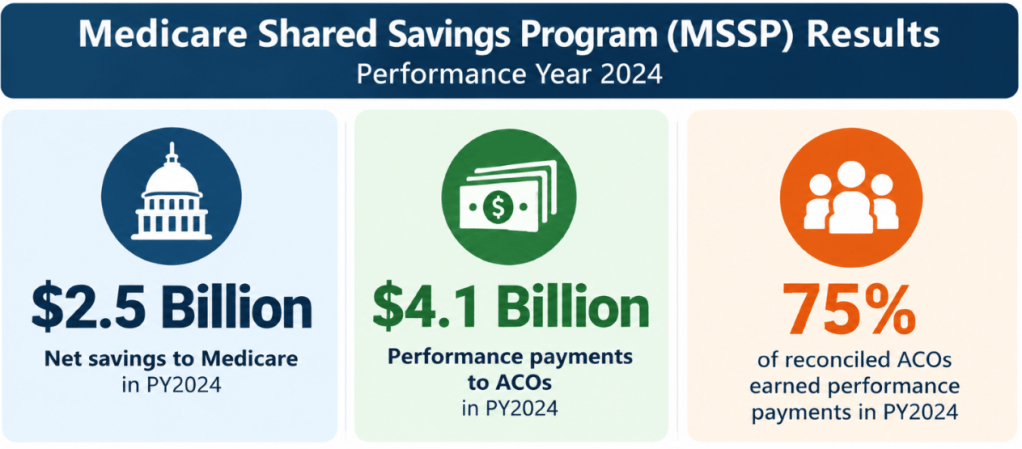
They can, but financial results depend on the specific payment arrangement and the organization’s performance under it. Value-based contracts may provide quality incentives, shared-savings payments or population-based payments, while arrangements with downside risk may require providers to repay losses when spending exceeds applicable targets. Savings to a payer are not the same as provider profitability. In performance year 2024, Medicare Shared Savings Program ACOs generated approximately $2.5 billion in net savings to Medicare relative to benchmarks, while 75% of reconciled ACOs earned performance payments totaling $4.1 billion. CMS data also show that some ACOs owed shared losses. These program-level results do not establish whether an individual hospital or health system was profitable under its value-based arrangements. [10]
CMS PY2024 MSSP fact sheet | CMS performance data
A provider’s financial result depends on factors such as contract terms, benchmark performance, quality requirements, attributed population, level of financial risk, share of savings or losses, changes in utilization and the organization’s costs to operate the arrangement.
Will value-based care replace fee-for-service?
Not in the immediate future. Fee-for-service remains a substantial part of U.S. healthcare payment: 39.7% of payments were in HCPLAN Category 1 in 2024. At the same time, value-based accountability can operate on top of fee-for-service payment. [4]
Medicare’s Transforming Episode Accountability Model (TEAM) illustrates this structure. TEAM is mandatory for eligible acute care hospitals in selected Core-Based Statistical Areas from 2026 through 2030. Participating hospitals continue to receive payment through Original Medicare payment systems, while CMS also evaluates episode spending against target prices and applies quality-adjusted reconciliation. Depending on the hospital’s track and performance, it may receive a reconciliation payment or owe CMS a repayment. [7]
CMS is also implementing the mandatory Ambulatory Specialty Model (ASM) beginning with the 2027 performance year. Eligible specialists treating Original Medicare patients for heart failure or low back pain in selected geographic areas are required to participate when they meet the model’s eligibility criteria, and future Medicare Part B payments are adjusted based on model performance. [8]
These models demonstrate that fee-for-service and value-based payment are not necessarily mutually exclusive. Providers may continue to receive service-based payments while also being accountable for quality, episode spending or other performance requirements under an APM.
References
[1] Porter, Michael E., and Elizabeth Olmsted Teisberg. Redefining Health Care: Creating Value-Based Competition on Results (2006). View source
[2] Centers for Medicare & Medicaid Services. Alternative Payment Models (APMs). View source
[3] Health Care Payment Learning & Action Network. Alternative Payment Model (APM) Framework. Factsheet | White paper
[4] AHIP. 2025 APM Measurement Effort: Methodology and Results Report (calendar year 2024 data). View source
[5] Centers for Medicare & Medicaid Services. 2026 Medicare Accountable Care Organization Initiatives Participation Highlights. View source
[6] CMS Innovation Center. Long-term Enhanced ACO Design (LEAD) Model. View source
[7] CMS Innovation Center. Transforming Episode Accountability Model (TEAM). View source
[8] CMS Innovation Center. Ambulatory Specialty Model (ASM). View source
[9] CMS Innovation Center. Advancing Chronic Care with Effective, Scalable Solutions (ACCESS) Model. View source
[10] Centers for Medicare & Medicaid Services. Medicare Shared Savings Program: Performance Year 2024 Financial and Quality Results. View source
Find out more about value-based care
To learn more, explore the following resources:
- Healthcare 2030: Still waiting for value-based care
This special report—published in 2023—assessed why employers had lost confidence in the healthcare industry’s ability to move the needle on value-based care. It also offered tips for negotiating value-based care contracts. - Healthcare reimbursement: Succeeding under value-based and FFS payment
There are many different types of reimbursement models, from fee-for-service (FFS) to value-based payment and shared savings. This article explains how four common types of value-based payment models work. - HFMA’s Healthcare CFO of the Future report: Turning risk into opportunity
There are two areas where today’s CFOs need to become increasingly well-versed: moving toward value-based care and addressing the consumer experience, an HFMA survey of healthcare CFOs found. HFMA’s Healthcare CFO of the Future report explores the steps healthcare CFOs should take to succeed in a value-based care environment. - Value-based care adoption grows, but challenges remain
As healthcare costs began to outpace improvements in quality of care, by 2010, efforts to strengthen healthcare value began in earnest. Here’s a look at where those efforts stand. - HFMA’s Value Project
Discover the history of the value-based care movement in healthcare and explore foundational strategies for improving value in this HFMA series of reports. - Value in Practice: Digital Strategies That Support Value-Based Care
This on-demand webinar explores how financial strategy, population health operations and digital innovation can support value-based care. - Finding the Future of Value
This bite-size learning examines the underlying drivers of healthcare costs—such as chronic conditions, behavioral health, social determinants of health, and end‑of‑life care—and how they shape the future of value‑based care. - Join the discussion around value-based care on HFMA Community.
