


Healthcare Finance Technology
The Hospital of the Future Part II: Technology drives a new era of healthcare
As technology reshapes hospitals and health systems, leaders weigh investments that aim to improve care, reduce costs and strengthen financial sustainability.

Published
October 27, 2026
8:00 am
|
Updated
November 13, 2026
9:52 am
With support from:







Lee Health is building the infrastructure for smart rooms at its facilities. At Golisano, in Southwest Florida, smart patient rooms enable parents who can’t be at the bedside to join physician rounds virtually, hear updates from their child’s care team and ask questions in real time.
Ten years ago, Lee Health set out to create smart hospital rooms that would improve the patient experience by providing real-time health information, connecting patients and families and supporting clinical workflows. Today, leaders say one of the greatest returns is the extent to which clinicians have embraced the innovation.
“It’s really about making the room part of the care team,” said Jonathan Witenko, system director of digital transformation for Lee Health, a five-hospital, not-for-profit health system in Southwest Florida.
As the health system continues on its smart-room journey, every bed in its children’s hospital, Golisano Children’s Hospital in Fort Myers, Florida, is outfitted with futuristic technologies, from interactive televisions to digital whiteboards — including a custom-designed whiteboard for neonatal intensive care unit (NICU) patients.
“We took a close look at, ‘How do we use the room to augment the coverage of nurses, doctors and other professionals to gain as much insight into the patient’s health as possible while offloading some of the manual, repetitive tasks they perform, like checking a patient’s blood pressure at 2 a.m.?’” Witenko said.
“For instance, we’re exploring an incontinence sensor in our skilled nursing and memory care units that can alert teams to the need for assistance,” he said. “There are also ambient technologies that can continuously track vital signs and patient movement and prompt nurses to check up on the patient. And all of this information can be integrated directly into the EHR in real time, capturing trends for the care team.”
Survey Question
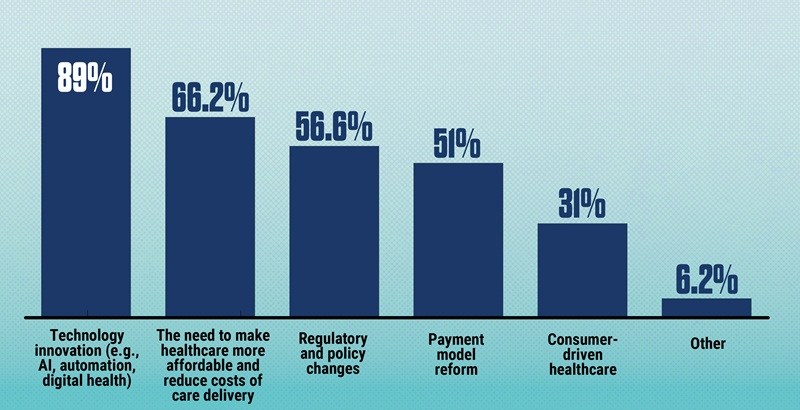
In your view, what are the forces that will reshape healthcare the fastest?
Note: Survey participants could select more than one response.
Source: HFMA survey of healthcare finance professionals, Jan. 27-Feb. 16, 2026
A future-focused strategy with a systemwide vision
Now, Lee Health is building the infrastructure to expand the approach across all its hospitals. Future iterations of smart rooms will be able to detect which physician or nurse has walked into the room and display their information on the whiteboard for patients and families to see. One important aspect of this process: rethinking the experience of care with technology and applying that vision fully to plans for investment, Witenko said.
At Golisano, smart patient rooms enable parents who can’t be at the bedside to join physician rounds virtually, hear updates from their child’s care team and ask questions in real time. Pediatric patients enjoy TVs equipped with a PlayStation and children’s movies. For NICU parents, access to educational videos via a TV at their infant’s bedside ensures they stay on top of discharge requirements.
“Now, we can start to work toward, ‘What does the future look like?’” Witenko said.
“Even for technologies that haven’t been invented yet, we can create a foundation to incorporate those technologies into the patient room.”
Nearly nine out of 10 healthcare finance professionals surveyed by HFMA believe technological innovation will be the force that reshapes healthcare the fastest over the next decade.
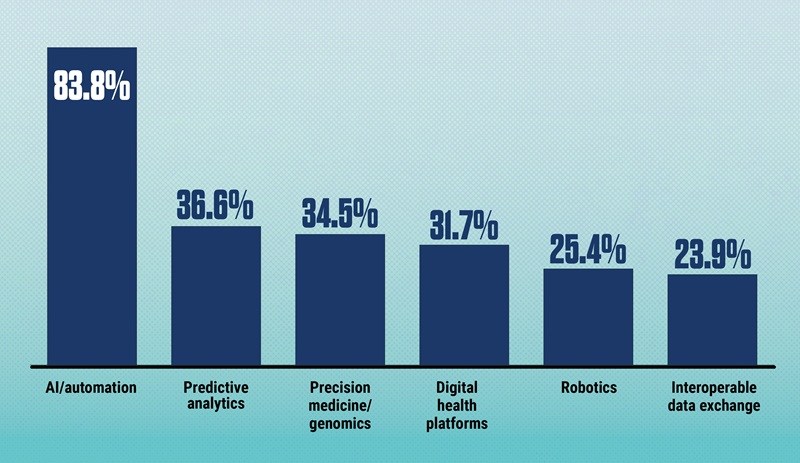
Among the specific technologies leaders say will push hospital innovation forward, AI/automation overwhelmingly ranks at the top at nearly 84%, according to an HFMA survey. Predictive analytics ranks second at nearly 37%, closely followed by precision medicine/genomics at 35%. (See the exhibit below.)
Survey Question
Hospitals will be most fundamentally reshaped by which technologies in the next decade?
Note: Survey participants could select more than one response.
Source: HFMA survey of healthcare finance professionals, Jan. 27-Feb. 16, 2026
Determining how to approach health tech investment
As healthcare leaders significantly ramp up investments in digital tech, two questions will demand their attention:

- Where are the best places to deploy tech investments to improve quality of care and the patient experience while protecting financial sustainability?
- What will new capabilities — including AI and automation — mean for operations and the hospital workforce?
Forward-thinking leaders are evaluating ways to drive innovation and protect the long-term financial health of their organizations.
“It’s not always about dollars and cents in today’s space, because making the wrong decision today will cost us far more in the future,” said Chris Allen, executive vice president and CFO for UChicago Medicine.
“Whether to replace equipment on a nursing floor with today’s technology or look at tomorrow’s technology, knowing that it might be more expensive, but it could advance patient care for the future — that is the type of question we ask ourselves every time we consider a new technology investment,” Allen said.
Healthcare innovation requires financial discipline

When Jeff Gautney, senior vice president and CIO for Rush University System for Health in Chicago, thinks about the future of healthcare, he envisions a model where patients are more empowered to take care of themselves and live longer lives.
He believes the hospital of the future will equip consumers with the tools they need to manage their health, connect with their care teams and navigate care more easily.
“It’s essential to our survival to be an AI and digital organization,” Gautney said. “We’re becoming known in our market as an organization that is learning how to wield these technologies and is comfortable putting out solutions that meet the needs and desires of our patients and our consumers — and that positions us to grow.
“It’s not a question of whether we need to invest in digital transformation. When we weigh digital investments, there’s a lot of discussion with our digital transformation committee.”
Gautney said key discussion points have included:
- Can we be successful at this?
- Do we have the right sponsorship?
- Is there a market for this?
- Is this a capability we could grow into?
“We’re not a poor organization, but we’re also not a gigantically wealthy organization, so we need to be very careful with the choices we make and choose the technologies that we know we can be successful in deploying,” Gautney said.
As leaders commit to digital transformation, one HFMA survey respondent anticipates access to real-time intelligence will be a defining characteristic of the hospital of the future.
“AI will shift healthcare finance from retrospective reporting to predictive analytics, enabling proactive intervention for both clinical outcomes and financial performance before issues materialize,” the survey respondent wrote.
Survey Question
In your view, where will AI deliver the most value for hospitals in the next decade?
Participants’ top three responses:
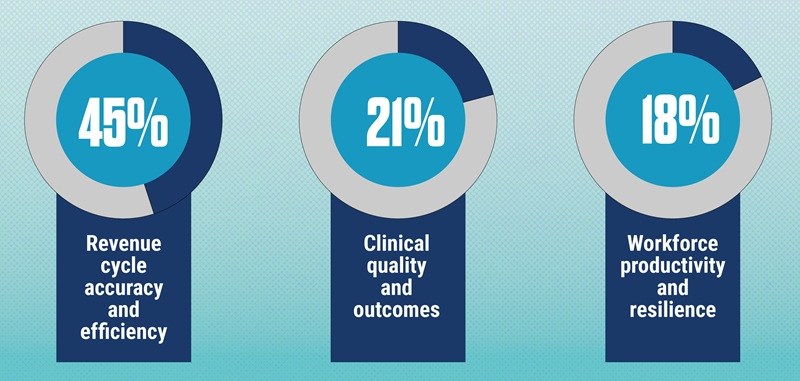
Note: Survey participants could select more than one response.
Source: HFMA survey of healthcare finance professionals, Jan. 27-Feb. 16, 2026
Personalizing care with technology
At Peoria, Illinois-based OSF HealthCare, leaders launched an automation imperative in 2024 aimed at generating $200 million in financial impact from the use of automation and AI over a 10-year period. Today, the health system has documented nearly $98 million in positive financial impact in expense savings and revenue gains through AI and automation initiatives, said CFO Kirsten Largent. One initiative — My Visit Guide, a digital tool that personalizes the care preparation experience for colonoscopy visits — decreased colonoscopy cancellation rates by 18% in one year. It did so by reducing the fear and uncertainty associated with this procedure.

Developed by the OSF Innovation Studio and the health system’s digital innovation development team, My Visit Guide generated estimated financial savings of more than $900,000 in its first year.
Largent acknowledges that the $200 million automation imperative initially drew concern from staff.
“It was a bold goal,” she said. “We tried to break it down to: ‘What does that really mean as far as a percentage of our overall expense and our cost structure?’”
Sharing successes has been key, she said.
“We have a dedicated team for margin sustainability, and we do a monthly report-out to our One OSF team, which includes all of the presidents from our OSF hospitals and the senior vice presidents at our central ministry services,” she said. “That continuous transparency and measurement and showing of the wins helps get all of our mission partners excited about how they can make an impact.”
But for many organizations, financial ROI from digital investments has so far proven challenging to achieve. As a result, some have started to judge transformational technology investments by their long-term operational value, rather than immediate ROI.
Survey Response
“The hospital of the future will decisively integrate AI with human potential. We will harness AI to enhance both everyday essential tasks and complex procedures. … Sustainability will be a top priority, ensuring optimal care to patients while keeping healthcare costs manageable for both patients and facilities and maintaining a steady revenue stream.”
HFMA survey respondent
Smart walls and long-term payoffs

When discussing high-cost, high-impact technology investments like a smart wall initiative, Alyssa Kasiewicz, Lee Health vice president and chief nurse and operations executive for children’s health, frames discussions around the performance metrics that demonstrate value.
“We’re not going to have dollar-for-dollar ROI, but having the patience to wait for the impact on metrics like coordination of care, length of stay and readmissions is critical,” Kasiewicz said.
“Those types of metrics, I think, will be lagging, but I think we’ll see them. We had philanthropic support to install [smart walls] at our children’s hospital, which is why it was an easy win. But it’s an investment to install that in all of your legacy infrastructure.
“When I think about the hospital of the future, or the hospital room of the future, it really is about using technology to the highest capable level to ease the burden for our clinical teams that are caring for our patients. And we’ve only just begun.”
Aligning tech investments with strategic priorities
When it comes to determining where to deploy transformational tech, leaders agree: There must be a business case associated with investment.
“We don’t pursue technology just for technology’s sake,” said Gautney of Rush. “It really is about ensuring that those are investments that align with our strategic priorities and position us for the future of healthcare delivery.”
For Gautney, other key considerations include whether the health system has:
- The finances to support the technology
- Teams that are willing to sponsor and own the tech
- Executive leadership support for the investment
- Confidence in the potential for ROI
“It should be core to how we think about the future of how we’re going to deliver care,” he said.
One digital initiative at Rush is Rush Connect, which delivers virtual specialty care in 10 specialty areas, from women’s health to sports cardiology, cancer second opinions, transplant intakes and more. The impact on reputation scores and net promoter scores has been striking: 93% of patients who use the virtual specialty care program would recommend Rush to their family and friends.
Digital initiatives like this are also expanding the health system’s reach. Among cancer second opinion patients, 92 of 113 patients seen during a recent four-month period were new to Rush.
“We’re expanding the different types of people we can provide service to, which is a big part of the goal,” Gautney said.
Taking a measured, disciplined approach to digital innovation ensures teams don’t lose sight of the objectives for the deployment, according to Allen of UChicago Medicine. It also positions teams to move quickly when it comes to implementation.
“We forget sometimes that if you throw 15 projects at the same group of people at one time, nothing gets done,” Allen said. “So, setting priorities around what is most important — and making sure that initiatives get done in an efficient, effective manner — is essential. And then, you know, speed is everything. It’s everybody’s mantra: ‘We’ve got to get it done fast so we can move on.’”
Assessing the human impact of innovation
Increasingly, healthcare leaders are being called on to increase efficiency and remove administrative burden that limits the time clinicians can spend with patients and increases healthcare costs. By 2035, PwC anticipates that $1 trillion in annual healthcare spending will be redirected toward next-generation, AI-supported care.a

“This has a benefit not just in reducing staff turnover, but also in improving clinician satisfaction and patient satisfaction,” Gautney said. “Patients feel like they’re being heard and have more time with their clinician, while clinicians gain the capacity to treat more patients because technology is helping them become more efficient and effective.”
But there’s no denying that engineering the hospital of the future is a difficult and highly complex endeavor. Such work comes at a time when many hospitals face intense pressure to increase human capacity with AI amid staffing and resource constraints.
Lee Health’s Witenko has this advice: Create a digital transformation road map — and implement it at a pace that aligns with your organization’s priorities.
“I think the health systems out there that are overwhelmed with digital transformation because it’s expensive need to know: You don’t have to eat the elephant in one bite. It’s really one bite at a time,” Witenko said.
Footnotes
a. PwC, From breaking point to breakthrough: The $1 trillion opportunity to reinvent healthcare, Sept. 17, 2025.
b. HFMA survey of healthcare finance professionals, Jan. 27-Feb. 16, 2026.
PHOTOS BY MARSHALL CLARKE; COVER ILLUSTRATION OF AN IMAGE BY MARSHALL CLARKE
4 ways CFOs can be architects of digital innovation

1. Strive to be technology savvy. Establish a strong relationship with the organization’s chief AI officer or another top IT lead. “Having a safe space where I can ask questions about what a particular technology can do has been really critical,” said Nick Barcellona, CFO, WVU Medicine, based in West Virginia.

2. Double down on workplace culture. “Technology alone isn’t going to cause the transformation or improvements,” said Kirsten Largent, CFO for Peoria, Illinois-based OSF HealthCare. “We really have to pay attention to workflow redesign to help ensure technology initiatives are successful. As we empower teams to be more successful with innovation, we’ve intentionally focused on culture, measurement and transparency in areas with high turnover or where we have difficulty recruiting. This allows us to learn from challenges quickly and pivot when needed.”

3. Look for opportunities to gain more from existing tech partnerships. Among those surveyed by HFMA, 44% expect technology vendor partnerships to be critical to hospital success.b “There’s so much new technology that’s coming out, and a lot of it is from small companies that have figured out new ways to do things,” said Matt Cox, FHFMA, CPA, executive vice president, CFO for Corewell Health in Grand Rapids, Michigan, and 2026-27 HFMA Chair. “There are a lot of opportunities to partner with these vendors in new and different ways.”

4. Be intentional in determining where to deploy new technologies. “As leaders, we’re going to have to be really specific about selecting use cases and giving people the tools they need,” said Cecelia Moore, MHA, CPA, CFO and treasurer for Vanderbilt University Medical Center in Nashville, Tennessee. “We’re going to have to say: ‘These are the 10 tools that we know other organizations are using. Let’s try to do this project. Let’s use the technology in this particular manner.’ I don’t think we’re there yet, based on the conversations I’m hearing — and we need to be.”
Missed Part I?
Read The Hospital of the Future: Can healthcare leaders deliver a healthier future? to explore how healthcare leaders envision the hospital of the future — and the challenges they’ll face in getting there.
This report was developed with generous support from HFMA business partners. In this supplement, they share their perspectives on the report’s findings and how healthcare leaders may prepare for healthier futures.
In a supplement to the report:
- Maxim Abramsky, AGS Health chief product officer, explained AI automation is powerful, but technical capability alone cannot show where it creates value.
- Ben Beadle-Ryby, AKASA’s chief revenue officer and co-founder, focused on AI-driven automation, clinical accuracy and a new operating model.
- Dugan Winkie, Cedar’s chief strategy officer, discussed purpose-built AI, patient financial experience and a more effective payment resolution.
- Hari Bala, Solventum’s chief technology officer, said connected workflows, AI and automation are key to more efficient, patient-centered care.
- Sanjay Kumar, XiFin’s chief technology officer, centered on agentic AI, intelligent automation and human oversight to resolve complex revenue cycle challenges.
